I actually started this blog piece in May and hoped to have it finished by at least the end of that month. However the COVID-19 pandemic increased the number of queries from the union members in schools I support, so after a long day in front of the laptop I was not very inclined to get writing. Somehow June has flown by, and now thanks to a week’s leave, and rainy weather, I have got round to putting the finishing touches to this long overdue post.
In October 2016 my wife Tina and our friend Moira went to Kraków, Poland, for a few days to celebrate Tina’s birthday while I stayed in Leeds to look after the hound. Tina’s tales of Kraków and hearty recommendation made it somewhere I wanted to visit too. So when I found out my Dad, who is very keen on history, fancied a trip there, we made plans to go at some point in the near future. There was some debate about what time of year was best to keep to a budget, yet not incur very cold weather. “Your owd man is too owd for traipsing around in a foot of snow”, my Dad sagely advised. I forget why we failed to go in 2018, but after a bit of faffing about, and reassurances that we wouldn’t be stranded in Poland due to Brexit, eventually I managed to get a bargain deal of £206 per person for 4 nights in early May 2019. “Swoop for it son”, came the instruction. In May there was the prospect of reasonable weather, and it was early enough on the year before the prices got daft. I find it hard to believe just over a year has passed since our Kraków experience, but I thought it timely to record it now.
Regular readers of this blog may recall my reputation for planning things in great detail. This is a trait I inherited from the Owd Man. So with two planning Pointons on the case, the preparations had a hint of military precision. Manchester Airport might have seen the logical departure point given it is between Leeds and Newcastle Under Lyme, yet the available flights left either one of us unable to get there by train in time, or unable to get home afterwards. However the flights from Leeds Bradford Airport were at far more civilised times, and with Dad a retired railwayman having free train travel, the plan was for us to meet at Leeds railway station, get the 757 bus to the airport, and be on an afternoon flight. “I’ve done a billy do of some train times”, Dad informed me by text message. He meant billet–doux. I explained that a billet–doux was a love letter, but apparently it was also what railway staff called notes of train times in Crewe Control. Well to be fair they do love their trains in Crewe.
So on the Monday morning of our adventure, the billy do doing its job, my Dad and I found ourselves at Leeds station in very good time for the next leg of the journey. Having factored in contingency time for any potential cock-ups, when the 757 airport bus pulled up at Leeds Bradford Airport, we were so early the Jet2 check-in gates for our flight hadn’t opened. The several hours wait before take-off dragged a bit, and I was glad when we were eventually in the air. The two and a half hours flight arrived around the scheduled local time of 6:30 pm, and I was glad we’d booked a surprisingly tasty in-flight meal to tide us over.
John Paul II Kraków-Balice International Airport was just over 10 miles away from our hotel. As it is connected to Kraków Glowny railway station, during the planning stage I had contemplated having a Polish railway experience to get to our accommodation. But having consulted the timetables and likely arrival time I concluded best stick with a taxi. We wandered out into the Polish evening to find a line of taxis awaiting us. We were greeted warmly by a middle-aged mustachioed fellow who introduced himself as Tomasz and helped us into his Skoda. The journey to our hotel was entertaining as Tomasz was quite the conversationalist, with topics ranging from the latest addition to the British royal family that day (he was much more enthusiastic than we were), to the local football derby between Wisła Kraków and KS Cracovia known as the Holy War (that’s more like it!) So enjoyable was the journey that Tomasz’s services were booked for the return to the airport on Friday.
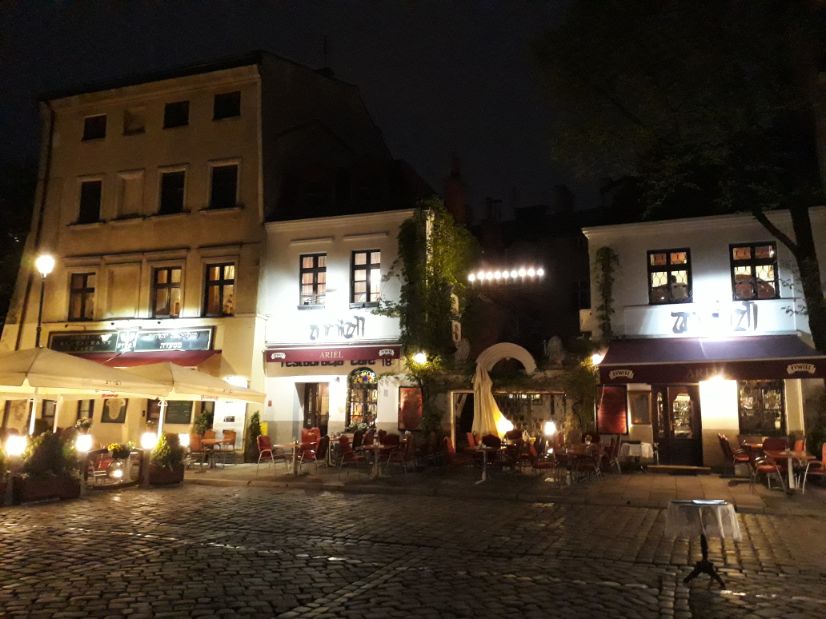
Szeroka Square and Ariel Restaurant
The hotel that Tina had stayed in, and highly recommended, was unfortunately booked up. However I had found a place a few minutes walk away and handily next to a tram stop – Hotel Kazimierz II. Dumping the bags we went off to explore, and find somewhere to get a bite to eat. Kazimierz is the name of Kraków’s historic Jewish quarter, and very close to our hotel was a small square off Szeroka Street, which once held the local market. As there are several restaurants there, with menus carefully examined online in advance, this was to become our usual haunt for the coming evenings. That Monday night we settled for Ariel Restaurant , in part because while peering at the menu outside, a persuasive waiter enticed us in. However as a first experience of an evening in Kraków goes, it was pretty special. We both enjoyed our meals, and the art adorned surroundings and atmosphere were fabulous. A couple of beers, and we headed back to the hotel for a bit of kip before the first full day in Kraków.
The first hotel breakfast, and indeed for all the other days, was the classic continental style laid out on a long table. There was also a small hot food section with usually two available items, changing daily, and providing a bit of comedy value as we tried to work out what they were. I opted for what I thought were a couple of hash browns only to find they were some sort of apple fritter affair. Anyway as it was pretty much an “all you can eat” arrangement, each morning we filled up on tasty fayre for the day ahead.
Tuesday’s itinerary was as follows: morning and early afternoon at the Polish Aviation Museum, the rest of the afternoon having a wander around the central old town of Kraków, and then the evening around the Jewish Quarter for a meal and beers. Naturally the planning had gone on for this well in advance, and I’d worked out that a tram that stopped 50 yards from our hotel would take us to the stop at the museum, and then it would be a 5 minutes walk to the entrance. We would then be able to get another tram from the same stop and disembark close to the old town. At around £3 for a day rider ticket, the tram system was a bargain. It was also an excellent way of getting around and experiencing part of Kraków life. There was a ticket machine at our local tram stop that had an English option, so purchasing tickets was easy, you just had to remember to date stamp them when you got on the tram to make them valid.
Our first tram journey went pretty well, fitting in with the friendly locals, and we got off at the right stop for the museum. Arriving at the pay counter we had the added bonus of discovering that entrance was free on Tuesdays. My Dad’s love of history sparked my own interest as a child, and back then we’d visited aviation museums like Hendon and Cosford. So this visit was a bit like a step back in time, only with me taking Dad, rather than the other way round. The Polish Aviation Museum site is quite large with several hangar sized buildings housing exhibits, and many more aircraft lined up outside. We ended up spending several hours there.
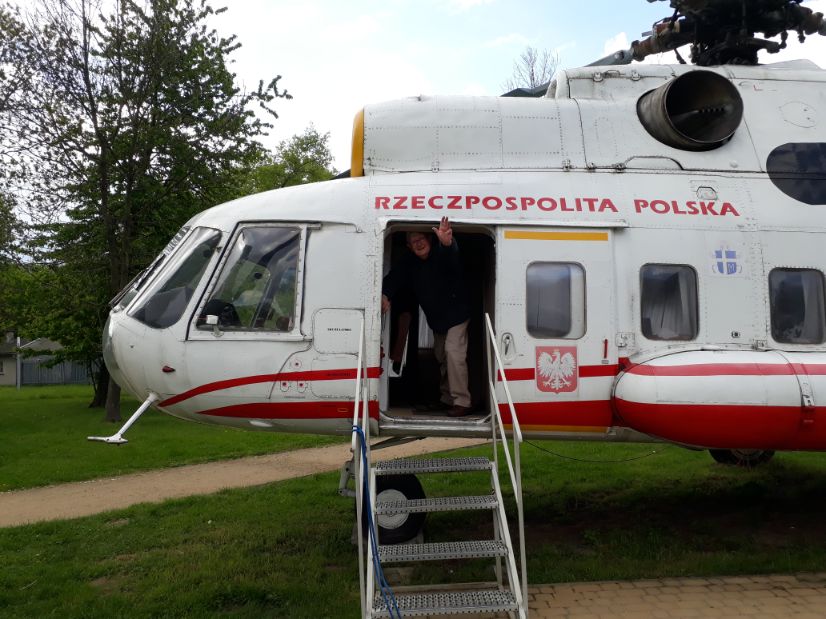
Pointon in Pope Copter
One of the main attractions for me was a 1918 World War I Royal Flying Corps Sopwith Camel, one of only five left in the world. Apparently this British aircraft had been forced to land at the German frontline and was captured. The Germans repaired the aircraft and flew it until the end of the war when it was then taken to Berlin and exhibited in an air museum. During World War II it was moved to Poland for safekeeping, and put into storage, eventually restoration being completed in 2010. Looking at the flimsy wood and canvas construction, it must have taken a brave pilot to set off on dawn patrol in one of those “kites”. There were more substantial aircraft there, including a German Junkers Ju 52 transporter plane from World War II, a Harrier jump jet, and a plethora of MiGs. There’s too many exhibits to list here, but for readers genuinely interested in this sort of thing there’s a photo gallery. One final aircraft worthy of a mention is the 1973 USSR built Mil Mi-8 helicopter as used by Pope John Paul II, and on this occasion, Pope Bernard I.
Having had our fill of aircraft we headed back to the tram stop and travelled into the historic central district of Kraków old town. The entire medieval old town is among the first sites chosen for the UNESCO’s original World Heritage List, and it’s easy to see why. 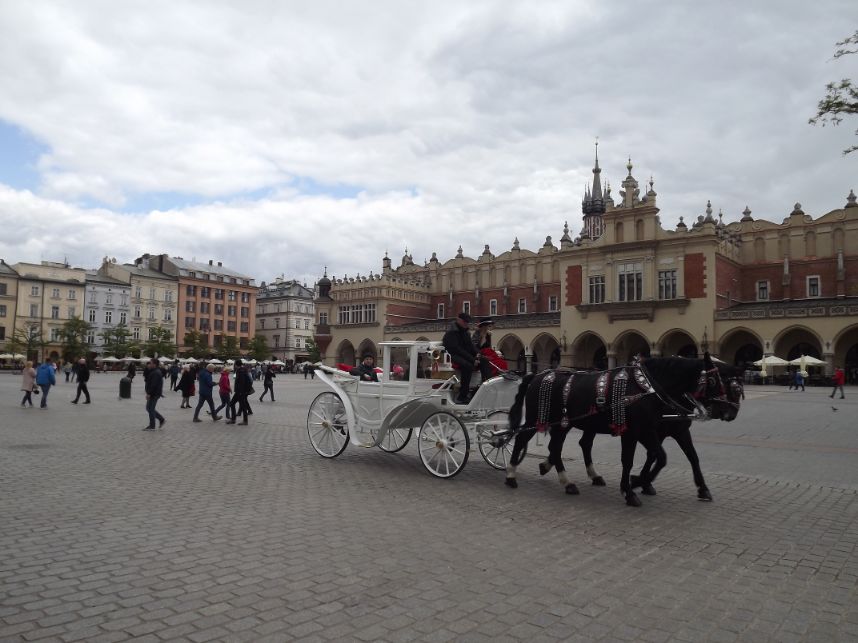 Dad and I wandered around the Main Square, apparently the largest medieval town square of any European city, admiring the exquisite architecture of buildings like the Cloth Hall and Town Hall Tower. Our walk also took in a number of beautiful churches. Many tourists seemed keen to take a ride around the square in the elegant horse-drawn white carriages, but we didn’t bother. Probably just as well, because thinking about it, all I can picture is something more akin to Steptoe and Son. Instead we decided to have a sit down to rest our weary legs, and have a coffee. We found a place called Cupcake Corner down a side street, and enjoyed a bagel and coffee each to keep us going until we had our evening meal. After relaxing for a while we found our way to Plac Wszystkich Świętych to catch a tram back to the hotel.
That evening, having consulted my pre-prepared crib sheet of possible restaurants, Dad and I set off again towards the square off Szeroka Street, and opted for the first place we encountered. This was Klezmer-Hois restaurant which is in a 14th century building that was once a ritual bathhouse. A young utterly miserable waitress led us through a warren of corridors past several dining rooms to what seemed the very furthest corner of the ground floor, into a large deserted room adorned with floral wallpaper, portraits and other pieces of art. I wondered if we’d inadvertently offended the waitress on arrival, and our punishment was to be ostracised in this distant, dark backroom, to be forgotten about. For some time we were the only people in there, but eventually we were joined by others who entered with the same bewildered look of “where is she taking me?”
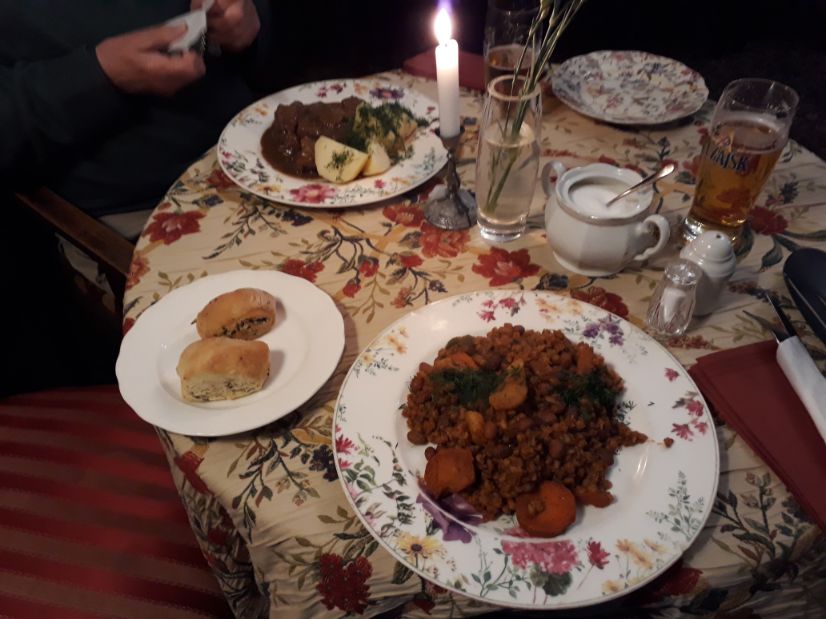
Klezmer-Hois meal
Anyway you couldn’t grumble about the food which was excellent, both of us enjoying our choices very much. I decided on the Vegetarian Cholent (Jewish stew), and Dad ordered the Beef Goulash, which I worried might be a tad adventurous for him, but no it was polished off. These were washed down with a Leżajsk beer. The waitress did eventually crack a warm smile when she saw the tip we left as we departed.
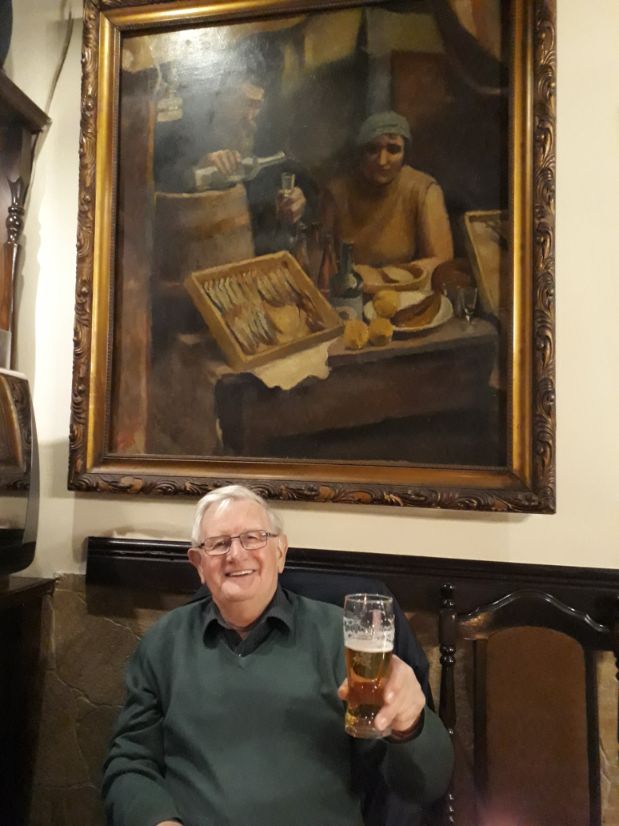
I’d been keen to sample some Kraków nightlife so naturally my pre-trip research had included a few bars we might try. I was particularly drawn to an establishment called Propaganda Pub, one of the oldest bars I the district, which I read played ska, reggae, punk, and rockabilly music, and had socialist memorabilia. Perfect. It was only a five minutes walk from Klezmer-Hois, so that was to be our first experience of a Polish pub. As we entered I wondered if I’d made the wrong choice. It was dimly lit, some might consider it a bit of a dive, and the clientele were all about half my age. Anyway the Owd Man seemed surprisingly unperturbed so we settled down at a small table and I got the beers in. The friendly barman poured us a couple of half litres of Zubr (Polish for Bison), a dark looking brew, which came to about £1.50 a piece.
My initial trepidation about the place subsided, and I started to enjoy the atmosphere. The walls had all manner of things hanging on them like old radios, bicycles, guitars, and the front end of a Trabant car. I might have felt that we both looked out of place there, but I got the impression nobody else felt we did or indeed cared. When it was time for a second drink I asked Dad if he wanted another there or to try another place. I was surprised and pleased that he enthusiastically said “Get another round in son!” A litre of Zubr each at Propaganda Pub had to suffice for the night as we had an early departure in the morning, we had a trip booked to the Auschwitz-Birkenau Memorial and Museum.
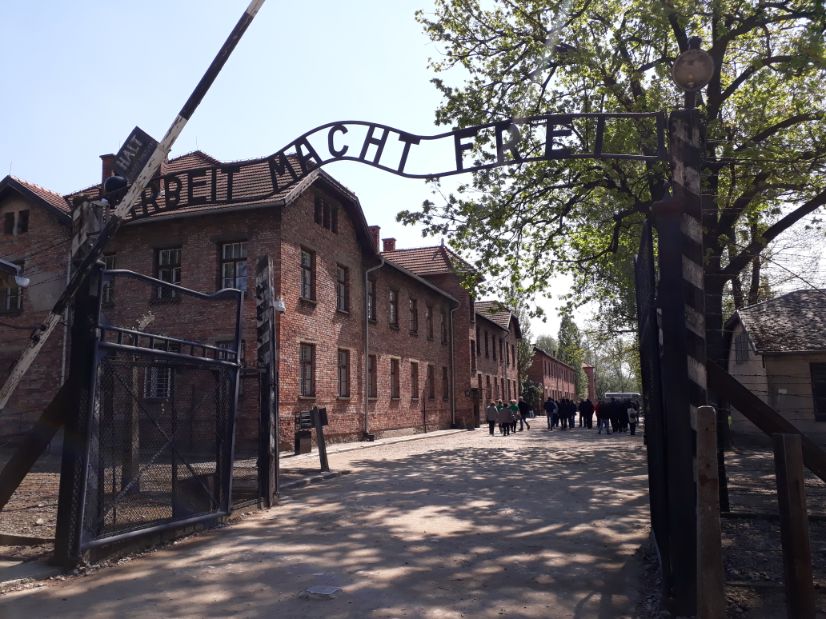 After another fine breakfast, on Wednesday morning we were picked up from the hotel by a guide in a Mercedes people-carrier at 8:30am. A few stops later to collect other customers, we were setting off on just over a hour’s journey to Auschwitz-Birkenau. I had an inkling we were close when I spotted a single railway line in the grass verge running for a while alongside a long straight road that eventually led to the museum coach park. I had a churn in my stomach when I saw that railway line, maybe a instantaneous realisation that it was likely to have brought countless people to their deaths. We got out of the vehicle, made our way to the entrance to meet our guide, and donned the headphones to hear her commentary. I’d seen the infamous “Arbeit Mach Frei” gates of Auschwitz many times in documentaries or photos, including those of Tina’s trip, but to actually walk through them was a very chilling experience indeed.
There have been many things written about Auschwitz-Birkenau over the years, pieces more eloquent than I could produce. It also does not seem appropriate to provide a descriptive account of our entire visit to the camp, as to me it could be seen as trivialising the atrocities that unfolded there to approximately 1.1 million people. The tour around the blocks housing the exhibits was full of evocative and appalling accounts. The whole visit was memorable and poignant, but there are two particular experiences I will expand on, because these affected me the most. The first was in Auschwitz camp Block 6 where we were led down a long corridor, and on each side of it were photographs of registered prisoners with their name, age, date of arrival at Auschwitz, and their date of death. 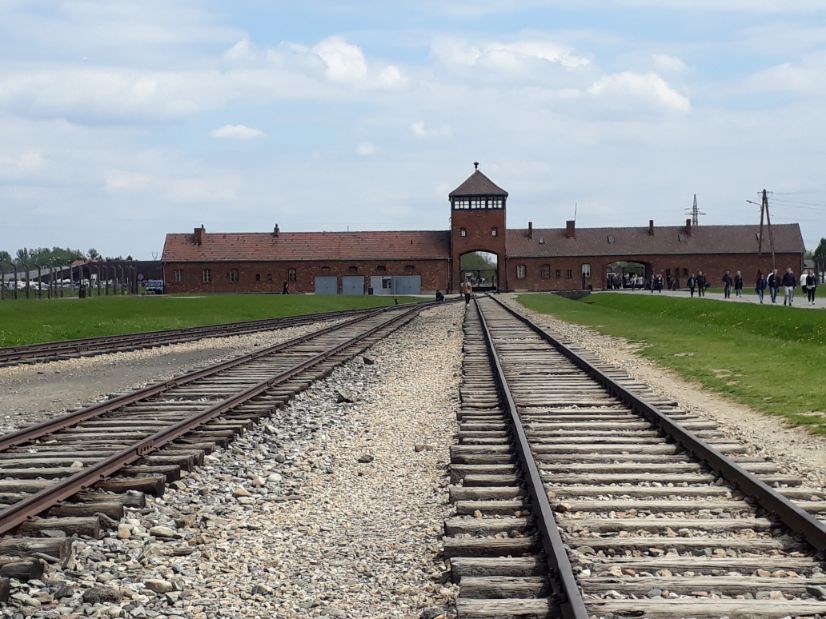 Seeing their actual faces, their ages, and the very short period of time they spent at the camp before they died had a great impact. The second moment was at Birkenau camp when we were led to the railway wagon that marked the place where people disembarked from the trains and met their fate. Stood there with my Dad (79 at the time) I realised that if it had been us getting off that train then most likely it would be the last time we saw each other. Dad would almost certainly be selected to be immediately murdered in the gas chambers, and at 47 I might have been joining him. Or I may have been sent for forced labour and expired of starvation a few weeks later. This passage comes from the Auschwitz-Birkenau Museum website:
Age was one of the principal criteria for selection. As a rule, all children below 16 years of age (from 1944, below 14) and the elderly were sent to die. As a statistical average, about 20% of the people in transports were chosen for labour. They were led into the camp, registered as prisoners, and assigned the next numbers in the various series. Of the approximately 1.1 million Jews deported to Auschwitz, about 200 thousand were chosen in this way. The remainder, about 900 thousand people, were killed in the gas chambers.
Retracing the final steps taken by those poor souls as they made their way to the gas chambers was a very sombre and thought-provoking moment. Although those buildings of murder are now razed to the ground, what took place there should never be forgotten.
The journey back to Kraków was in near silence. That evening the mood was lightened by another visit to our favourite square in Kazimierz, this time to the Awiw Restaurant. It was a pleasant evening, mild enough to dine outside, entertained by a trio of young musicians playing Klezmer music, adding to the atmosphere. This time I tried the mixed vegetarian pierogi (Jewish dumplings) whilst Dad had an enormous burger.
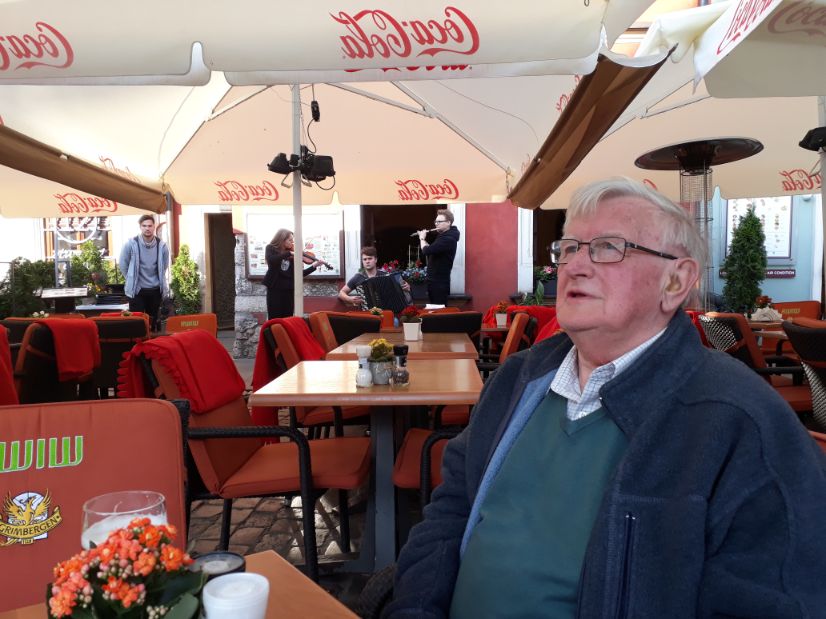
Awiw Restaurant meal and music
Once again the food and beer were very good. After the meal we had a walk around the Kazimierz district passing a number of lively bars and venues, before ending up alongside the Vistula River. To save our legs we jumped on a tram for a couple of stops to bring us back close to our hotel. We decided to have another beer but didn’t want to walk as far as Propaganda Pub. So we settled in Artefakt Café which was just over the road from our hotel.
Artefakt Café had one wall of shelves full of books, and the clientele was a youthful set, that mainly looked like students, engrossed in animated conversation. There were a few others in there equally engrossed with the Ajax v Tottenham Hotspur UEFA Champions League Semi-Final Second Leg. The visit to Auschwitz-Birkenau Museum had tired out the Owd Man so he decided at half time to head back to our room. I’d initially intended to escort him back then return to Artefakt Café for the second half. However I discovered the game was on one of the few channels the chunky portable TV in our room offered, so I remained there to watch an absolutely astonishing match as Spurs came from 3-0 down on aggregate, Lucas Mouras scoring a second half hat-trick including a 96th minute goal to win it on the away goals rule. An exciting end to the day.
For Thursday I’d booked in advance a tour of the Museum of Kraków at Oskar Schindler’s former enamel factory at Lipowa Street. The museum contains the permanent Exhibition of Kraków under Nazi Occupation 1939–1945. As our entrance time was 12:40 we had the morning to fill. Once again we swooped for a tram day rider ticket, and headed off towards the old town. I’d wanted to try to photograph the Wawel Royal Castle, which dates back to the 14th century, and is set on a hillside overlooking the river. It was the first day we’d had a bit of drizzle so the photos of the castle and nearby St Andrew’s church didn’t really do them justice. We retraced our journey on the tram, and got off at the stop near the hotel so I could nip back to the room to answer the call of nature. Dad remained in the tram stop shelter. When I got back he was sat next to two homeless men who looked like they’d been in a fight, their faces bloodied and bruised. “Take me photo son”, he said, cheekily borrowing their cup of loose change which he held out appealingly. Later when the photos of the day were shared on Facebook, his act was so convincing that there were suggestions that I’d knackered him out, when in reality we’d barely got going that morning.
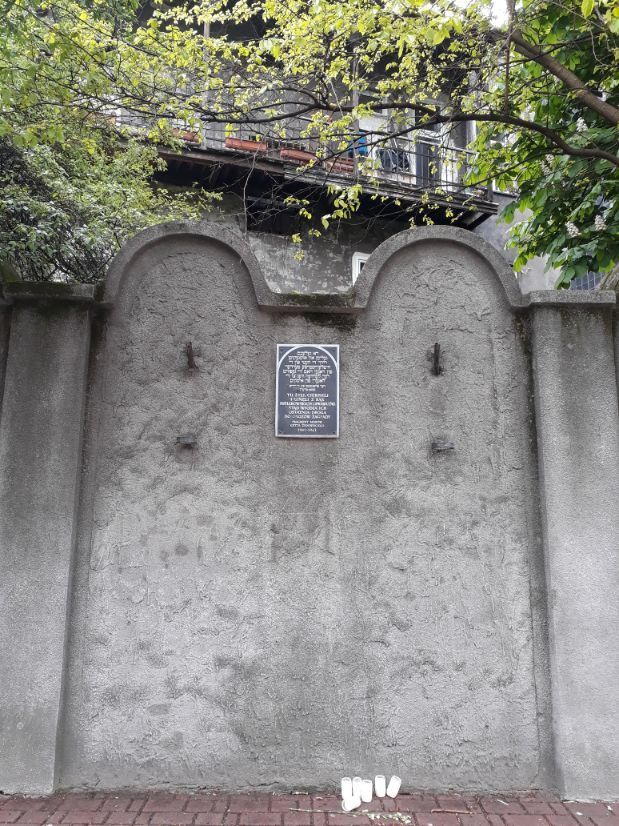
A part of the ghetto wall
I’d worked out that if we took the tram for a couple of stops, going over the river, we could get off at Plac Bohaterów Getta (Ghetto Heroes Square) and Schindler’s former factory was about a five minutes walk away. However we still had a while before we could enter the museum so we sought out a piece of the ghetto wall that remains today. The Nazi persecution of Jews in Kraków began immediately after the German army occupied the city in September 1939. In March 1941 the Kraków Ghetto was created in a part of the Podgórze district, and over 15,000 Jews were sent to it. Initially surrounded by barbed wire, in April 1941 Polish bricklayers began erecting a high wall around the ghetto with semicircular finials resembling Jewish gravestones. On 15th October 1941 the ghetto officially became a closed district, with a death penalty for anyone crossing it without a special pass. Fragments of the ghetto wall have been preserved in a couple of places and we saw the section at 27 Lwowska Street
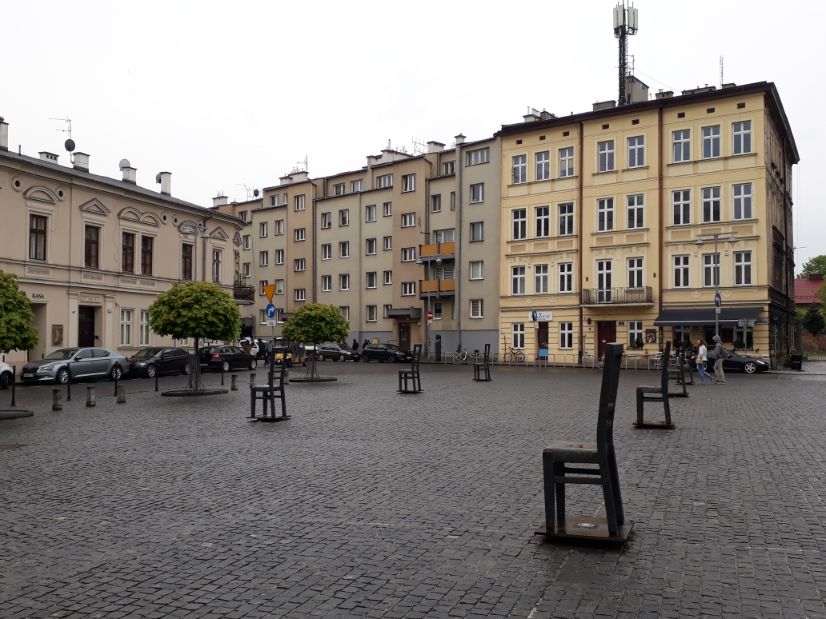
Plac Bohaterów Getta .
On the 13th and 14th March 1943 the Nazi SS carried out the liquidation of the ghetto and 8,000 Jews considered fit for work were transported from Zgody Square to the nearby Płaszów concentration camp. About 2,000 were murdered on the spot. After the war Zgody Square was renamed Plac Bohaterów Getta (Ghetto Heroes Square). In 2005 a monument commemorating the Kraków ghetto and Kraków Jews was unveiled, consisting of 70 empty chairs to symbolise personal possessions left in the square after the liquidation of the ghetto. Dad and I walked back from the ghetto wall fragment to Plac Bohaterów Getta, and it was hard to imagine that the it was the scene of so many atrocities nearly 80 years ago. The empty chair sculptures certainly are a striking memorial and an important reminder of the square’s history.
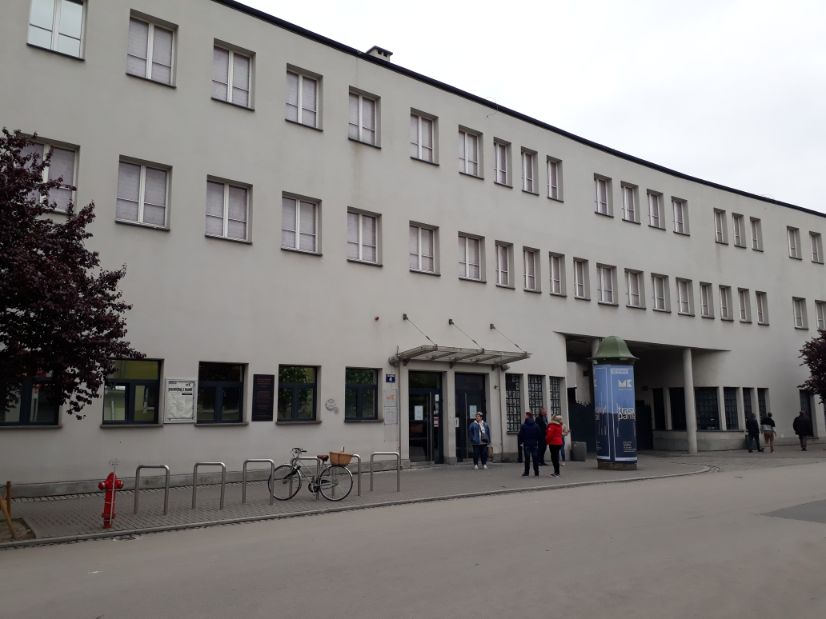
Oskar Schindler’s former factory
After making the short walk to Lipowa Street we arrived at the Museum of Kraków at Oskar Schindler’s former enamel factory which is dedicated to the history of the Nazi occupation of from 1939 to 1945. Like many people I guess, I became aware of Oskar Schindler due to the 1993 Steven Spielberg film Schindler’s List. Schindler (1908-1974) was a German entrepreneur and a member of the Nazi Party, yet he is credited with saving approximately 1200 Jews by employing them in his factories.
Tina had told me that this museum was not to be missed, and the entire Kraków trip had been chosen around dates when there were available visiting slots at the museum. Despite the scheme to limit numbers, the foyer was very busy on arrival, and getting in was a bit of a scrum. The museum’s popularity was well merited. The museum is organised in a very clever and captivating way. Each of the 45 rooms are set out in great detail to resemble a very specific place in a chronological order. A few examples include a cobbled street, a hairdresser’s salon, a tram, a labour camp, the railway station, the ghetto, and Schindler’s office.
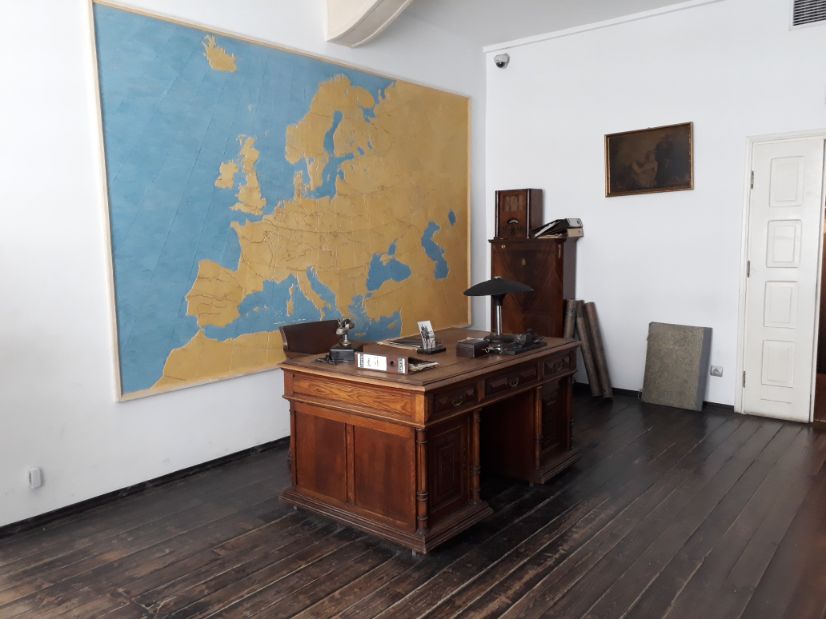
Schindler’s office
The use of interactive exhibits adds to the experience, with plenty of audio and visual material to engage with. You are left with a very real and sense of what life must have been like under the occupation, almost like walking through history. Dad and I spent 3 hours engrossed at the museum, but it could have easily been longer. It was one of the key highlights of the entire trip. For just over a fiver each it was an absolute bargain too. I highly recommend a visit.
After several hours on our feet it was the trusty tram that took us the half a mile journey back to the hotel, rather than Shanks’ pony. Keeping to the principle of stick with what you know, that evening we decided to return to the Ariel Restaurant for our meal. The portly waiter was rather exasperated with me as he proudly and flamboyantly read out a list of meat based house specialities only for me to plump for a vegetarian meal and ice cream for dessert. The ice cream seemed to be a particular insult, he wasn’t having this at all, refusing to take the order and pointing at better things on the menu. So when I changed it to crepes with apple filling and cinnamon sauce his smile returned and all was good. It was another succulent meal washed down with a beer. For our final night in Poland we returned to Artefakt Café for more beer as it was close to the hotel, once again mingling with Kraków’s hipsters!
The following morning as promised Tomasz and his taxi were bang on time outside the hotel waiting for us. Some final comments about the hotel. Our ground floor room was very comfortable and clean, and you couldn’t fault the breakfasts. The staff were also very friendly and helpful, so overall I’d recommend the hotel, especially as it’s a short walk from some pleasant restaurants and bars, plus it’s on a tramline. It may lack the charm of some of the hotels in the centre of the Jewish quarter, but for functionality, convenience, and cost I thought it was fine. As a place to rest your weary head at night, and have good feed in the morning, it was perfect.
Tomasz’s conversation and driving skills made the journey to the airport seem very short, and once again we found ourselves with plenty of time before our 10:50 flight. We had a smooth trip back, landing early in Leeds, and were soon on the 757 airport bus heading towards the city. After a few days of riding on public transport with quiet and polite Poles, witnessing some surly youth give the bus driver considerable grief because his banking app on his phone wouldn’t work to pay the fare was a bit of shock. By the time we got to the city centre it was around lunchtime. There had been talk of a final pint and a pub meal, or possibly us both going back to my house, but Dad was keen to get back to my Mum. So instead we ended up in one of the cafes in the arches by the station for some tasty chips and to consult the billy do before Dad caught a train to Manchester and then on to Stoke.
Our trip to Poland was a very enjoyable and memorable experience. We were lucky with the weather, it remained dry and mild for the majority of our stay, with just a bit of drizzle on the Thursday morning. We visited some very interesting places, and encountered friendly people wherever we went. There were plenty of laughs. But most important of all was the opportunity to spend some quality time with my dear owd Dad doing things that we both enjoy. It’s important to savour those moments especially thanks to COVID-19 we now haven’t seen each other for months. Kraków with Dad is a time I’ll treasure always.