Election Day 2015
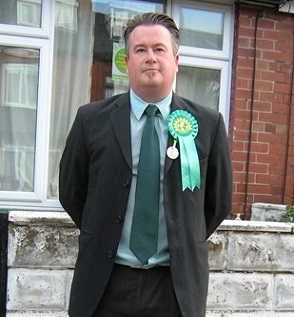
In 2010 I was Cllr David Blackburn’s Election Agent when he was the Green Party candidate for the Leeds West constituency in the General Election, which I’ve blogged about before. Five years later David didn’t want to stand again, and I had the honour of being selected as the Green prospective parliamentary candidate for 7th May 2015.
Standing as a parliamentary candidate was the realisation of a long-time ambition, ever since I become interested in politics around the age of 15. Back then I wouldn’t have anticipated standing for the Green Party, my allegiance lay with Labour at the time.
In 2015 the General Election date was the same as the local council elections. Therefore my campaign was always going to play second fiddle to the priority of getting Green Cllr Ann Blackburn re-elected in Farnley & Wortley ward, a far more realistic prospect than me finding myself in the House of Commons! There was an understandable nervousness in the party as the 2010 General Election had shared the same date as the local elections, and the higher turn-out led to the loss of a Farnley & Wortley ward seat to Labour. This was a huge blow, and it ended a 3 councillor dominance by the Greens stretching back to 2002. The Labour council election victor in 2010 was beaten by a Green in 2014, and was looking to use the General Election boost to get straight back into the Council Chamber.
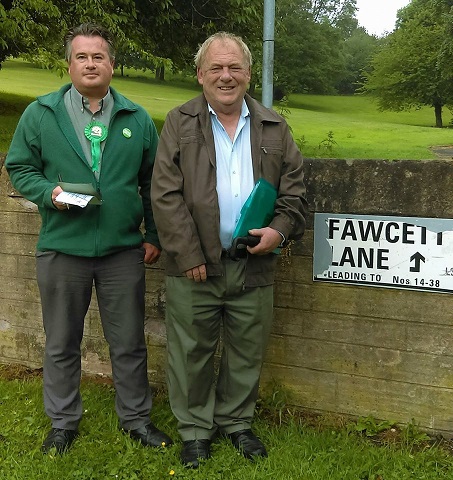
Canvassing with Cllr David Blackburn 2017
Therefore the majority of the leafleting and canvassing I did was on Ann’s behalf. Smaller parties like the Greens don’t have the resources of larger parties, whether it be funds or volunteer helpers. It often falls to a very small number of dedicated leafleters and door-knockers. Usually around three ward leaflets are delivered building up to the date of the local elections. In Farnley & Wortley that was close to 10,600 homes to visit for each edition of leaflet. Canvassing takes place all year round, but it is stepped up close to an election.
Canvassing isn’t my favourite pastime if I’m honest although it does have its moments. A favourite incident was in a road just off Old Lane in Wortley. I knocked at the second house and the door was answered by a neatly dressed man, in a shirt and tie, and smart cardigan, who I reckon was in his late sixties. He looked the sort of voter who cheerily praises the efforts of the hard-working local councillors, or has had a success story about his bin collection. I rattled out the standard opener:
“Hello, sorry to disturb you, I’m calling on behalf of the Green Party, and I wondered if you might be voting for us this coming election”.
The response was not exactly what I expected.
“I’m not bloody voting for that pair of pillocks from down Cow Close (surely he couldn’t mean the Blackburns?!), and I won’t be voting for that Reeves (the Labour parliamentary candidate) either, she never gets back to you. All of ’em are neither use nor ornament!”
And with that the door was slammed in my face. I bounded up the driveway chuckling to myself as I went. I decided to mark that voter down in the “undecided” column.
A General Election campaign costs a minimum of £500 for the deposit needed to stand a candidate, which is returnable if 5% of the vote is secured. Putting out a colour freepost leaflet by the Royal Mail to around 47,000 homes across the Leeds West constituency is not cheap and each General Election campaign costs the party close to £2,000. That’s a lot of money to a party like the Greens, but considerably short of the maximum spend allowed for each constituency which was around £28,000 at the time. So it’s a very uphill task for the smaller parties and independent candidates, particularly if there’s council elections to fight simultaneously. David Blackburn and I actually did a 10 miles sponsored walk around the constituency and neighbouring Pudsey to raise money for the campaign.
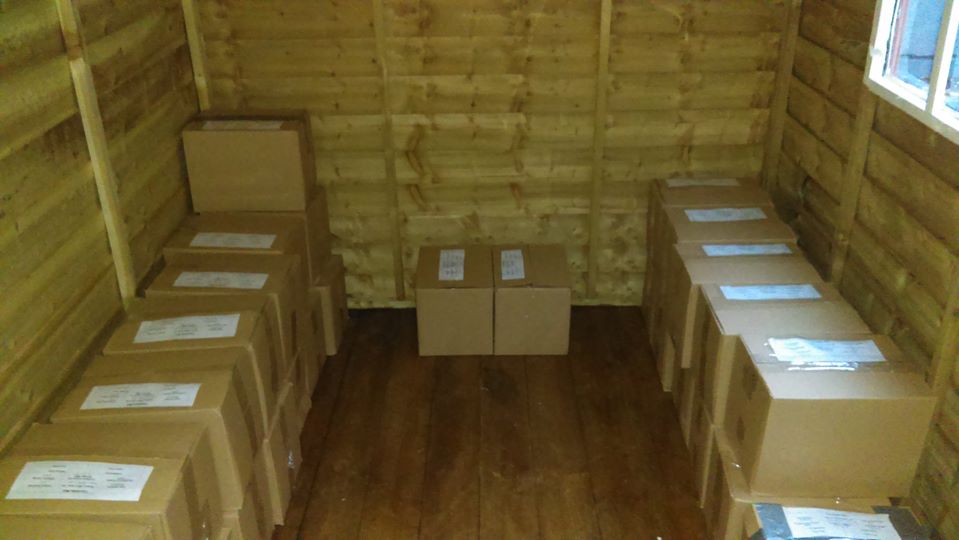
Around 47,000 boxed leaflets in my shed 2017
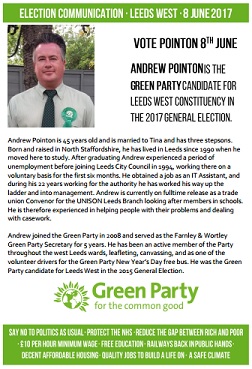
Getting a freepost leaflet out is a rather involved operation. I designed and wrote my own leaflet, arranged for it to printed, and collected the 45 or so full cardboard boxes from the printers, with the trusty Skoda estate under considerable strain. In 2015 these boxes took up temporary residence in the living room, but in 2017 I luckily had a new empty shed to store and sort them. The leaflet artwork has to be checked by the Royal Mail, and the correct number of boxes of leaflets labelled up for individual local sorting offices covering the constituency, reflecting the number of dwellings in each delivery area.
Finally on a date and time booked well in advance, I put all the boxes in my car, nursed it down the M62, and delivered them to the Royal Mail’s huge depot in Normanton. This is well frustrating as you know the boxes are then going to be taken straight back to Leeds by the Royal Mail and dished out to local sorting offices for posties to deliver.
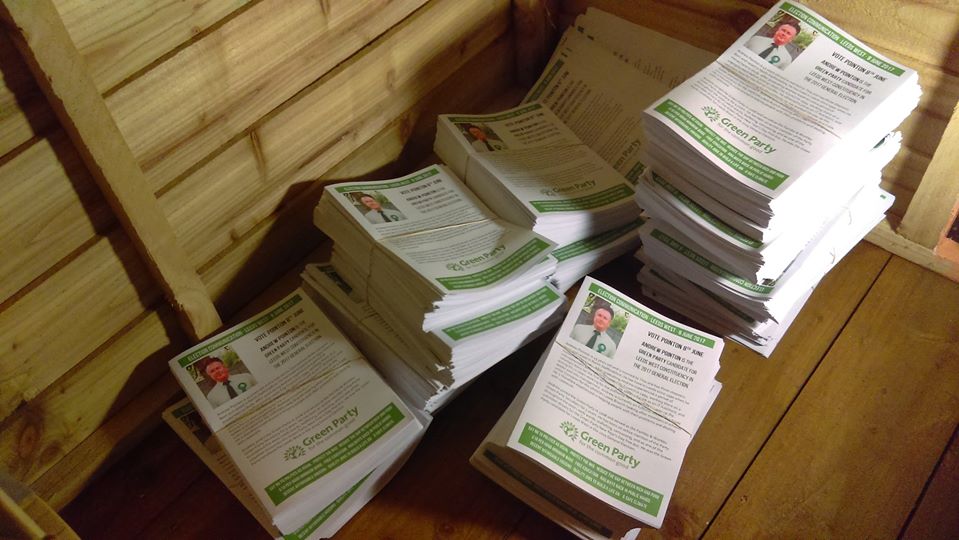
Vote Pointon!
All of this is against the clock, as the aim is to get the leaflets being delivered just before the postal vote ballot papers arrive at people’s homes. A missed deadline by the printers, or the artwork not meeting the Royal Mail requirements, and the whole process can be in jeopardy. All rather stressful. Then on election day speaking to people entering polling stations you find swathes of streets haven’t even received a leaflet and they are unaware there’s a Green candidate on the ballot. Later it becomes apparent many leaflets have even been delivered to homes in the wrong constituency. A right kick in the knackers.
While leafleting and canvassing for Ann Blackburn’s campaign took precedent, I was left largely running an online campaign. The Leeds West Greens’ website carried details about my candidacy, while I also setup a Facebook page and Twitter account for the General Election (AMP4LeedsWest). One of the strains on an independent candidate, or one running for a smaller party without a team of helpers, is keeping on top of the large number of emails you receive from constituents, especially when you’re trying to hold down a day job too. The number of organisations or NGOs providing people with easy ways to contact candidates to ask about specific issues they are interested in is great for democracy, but it produced a lot of emails to respond to. But I was determined to respond and I developed a number of standard response for each issue, which I’d then personalise to the individual story set out by the sender.
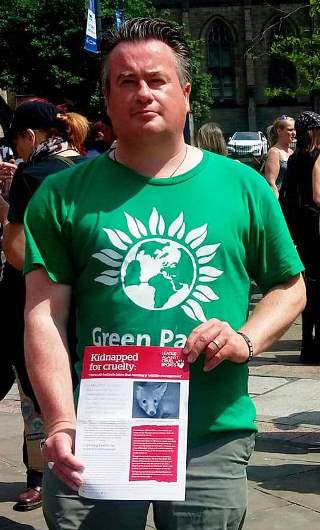
At an anti-hunting rally in Leeds
The one big frustration though was responding to questions like “Will you commit to tackling climate change?”, or “Do you believe in maintaining or extending the ban on fox hunting?” which of course are Green Party staples, and a quick look at our policies would answer the question. However I used all the responses as an opportunity to set out the Green Party position and then guide the enquirer towards the Green Party’s policies on the website. I actually got a lot of follow up emails thanking me for my reply and saying that other candidates hadn’t bothered.
In both 2015 and 2017 I did one hustings for each election, both of them arranged by residents in Bramley. I’m not a particularly confident public speaker so these were on the edge of my comfort zone, and being extremely self-critical, I don’t think they were my finest hour. Understandably to fit in plenty of questions, the candidates’ responses were limited to a minute for each question. Sometimes I would have dearly loved to have challenged the dubious statements of my opponents, but with only a minute I felt it best to trying to get across as much as I could about the Green Party position in a positive manner. I think my best moments were when I could draw upon my experience as a union Convenor representing members in schools, highlighting the effect of government austerity measures on schools, and the impact that had on the children.
An election campaign can be derailed by an unexpected event. In late Match 2015 I booked a week’s leave which I intended to spend leafleting. I had noticed 2 red marks on my left inner thigh, and didn’t think much of it, suspecting it might have been an insect bite from walking the dog in Middleton Woods a few days earlier. While leafleting in Bramley on the second day of leave I felt quite unwell, feverish, and nauseous. I felt devoid of energy and a round I’d normally have leafleted in about 30 minutes took almost 3 times that. I went off to a cafe for lunch, but had no appetite which is most unlike me! Without going into a lengthy tale, a large red rash developed on my thigh, my GP diagnosed cellulitis, and because it wouldn’t react to antibiotics I spent 4 days in hospital receiving stronger antibiotics intravenously every 4 hours. Once discharged I had to rest for several days on the sofa or in bed. So I lost a week of dedicated campaigning which was a blow, but I was told I could have lost a leg or even died which was a tad sobering!
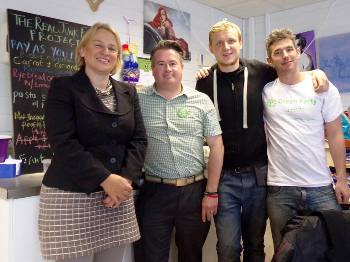
Natalie Bennett & Andrew visit The Real Junk Food Project Cafe
In 2015 I was helped by having active candidates in the 3 other wards in Leeds West, but particularly in Armley ward and Kirkstall ward. We developed a leaflet for each of these 3 wards which introduced the candidate on the front page and set out some key Green policies, while on the back there was a piece about Green achievements in Leeds, local ward issues, and what the candidate’s priorities for the ward were. We didn’t have the finances to leaflet all parts of each ward, but I believe the local ward candidates did help boost my votes in 2015. Nick Crawley’s 1108 votes in Armley saw the Greens finish 3rd, Kate Bisson polled 791 in Bramley & Stanningley, and Meadow Hudson came 2nd in Kirkstall with an impressive 1755 votes. The then GPEW Leader Natalie Bennett came to Leeds a couple of times in the run up to the 2015 election and I spent some of the day with her visiting projects across the constituency like the Real Junk Food Project in Armley.
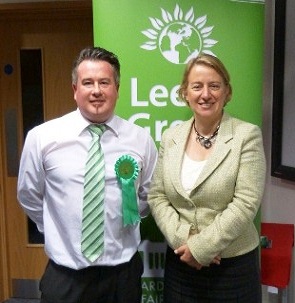
Andrew & then GPEW Leader Natalie Bennett in Leeds
On election day 7th May 2015 I voted myself in Leeds Central then spent the day at Green Party HQ in Farnley, driving voters to polling stations, or driving to polling stations on a regular basis to collect the number of people who had voted from the Presiding Officers. We could tell that turn-out was up, but we weren’t sure how that was going to translate into results. At lunchtime my agent, Nick Crawley, and I continued the election day tradition of a portion of chips at lunchtime from the usual chippy. In the evening I drove around the constituency with David Blackburn encouraging people to vote Green through a loudhailer. Eventually it was time to head to Leeds Arena for the count.
Seeing the BBC exit poll projected Tory majority materialise as the night went on was depressing. However watching the votes get counted for Leeds West things looked promising. Maybe some of the left leaning voters, particularly the young, were giving up on Ed Milliband’s Labour, and voting Green. There was some media excitement in the hall when the Shadow Chancellor of the Exchequer Ed Balls narrowly lost his Morley & Outwood seat to the Tories. It’s hard-going on election day when you spend close to 24 hours without sleep, fueled by mainly snacks and coffee. Eventually the Leeds West result was ready to be declared, and candidates and agents were taken into a small room to be told the result. I was in a bit of a daze when I went up the steps to the stage for the official announcement because the Green vote was even better than expected.
I had 3 main targets for the 2015 General Election: get back the deposit (poll 5% or more), achieve the best result ever for the Greens in Leeds West (previously 8%), and if possible take 10% of the votes. I managed 2 out of 3! My 3,217 votes (8.4%) was the best ever Green result in the Leeds West constituency. It was the best Green Party result in the city based on percentage of votes, but Michael Hayton gained more votes (3,558) in Leeds Central (7.9%). Four Green General Election candidates retained their deposit in Leeds, which was quite an achievement.
Ann Blackburn was returned as the Councillor for Farnley & Wortley ward in the 2015 council elections, receiving 3,831 votes (36.5%) with Labour coming second with 3208 votes (30.5%). The result meant that the Green Party retained 3 Councillors in the Farnley & Wortley ward. So it had been a good night for the Green Party in Leeds, while in Brighton Pavilion Caroline Lucas kept the seat with an increased shared of the vote, and boosting her majority from 1,252 to 7,967. It was a dreadful shame that while locally we were happy with the results, nationally we were stuck with a Tory majority government.
That Tory majority didn’t last quite as long as we anticipated it would. Despite saying she wouldn’t, on 18th April 2017, Prime Minister Theresa May announced she would seek an election on 8th June, hoping to secure a larger majority to strengthen her hand in the forthcoming Brexit negotiations. I remember hearing the announcement as it happened, on the car radio coming back from a union meeting at a school. Within a hour David Blackburn was calling me to sound me out about standing again. After discussing it with my wife Tina who’d not seen a lot of me during the 2015 election, I agreed to do it on the basis I couldn’t give 100% towards the campaign due to work and family commitments.
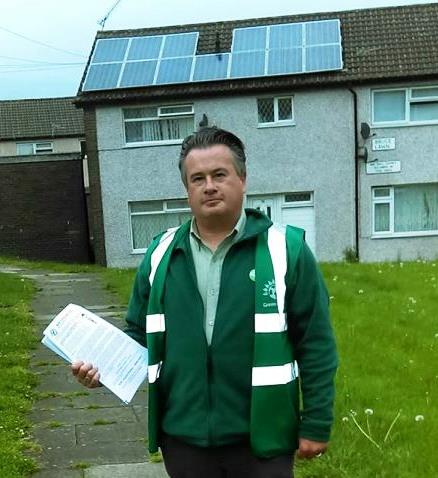
Leafleting in Wortley 2017
The 2017 General Election was different to 2015 in several ways. Firstly I had to fight a selection contest within the local party, which I edged based on my previous experience of a campaign, and the advantages of knowing what to do in such a short campaign period. Secondly I didn’t have a local election to work on too, it was all about the General Election, although the unexpected nature of it meant there was little time to prepare and we were short of funds. It was agreed it would be a campaign largely based on getting out a freepost leaflet and online methods. Thirdly the result was a complete reverse of 2015. Instead of the best result in Leeds West, squeezed by what turned into a national two horse race between Labour and Tories, I achieved one of the worst for some time, polling 1,023 votes (2.4%). However in Leeds West only the Labour and Tory candidate retained their deposits. Third placed UKIP, which got 18.5% in 2015, slumped to 4.3% in 2017. I should have quit when I was ahead, and not stood in 2017! Nationally Caroline Lucas increased her share of the vote to 52.3%, and the national Tory working majority of 17 was wiped out, leaving the nation with a hung parliament with the Tories the largest party forming a minority government. So started two years of a bizarre political period with Brexit dominating everything as a result.
When at the end of October 2019 Boris Johnson called yet another General Election (for 12th December), I was approached again about being the Green candidate for Leeds West. This time I declined because if I’m honest my head wasn’t in the right place, and I had so much on with my union role that I couldn’t face the additional stress of an election campaign. Billed as the “Brexit election” I also suspected it would be another where the votes would be going to Labour and the Tories, and another drubbing for smaller parties was on the cards. Victoria Smith did eventually improve on my 2017 outcome for the Green Party, securing 1,274 votes (3.2%).
 I found being a candidate to be many things. It was fun, exciting, fulfilling, but also stressful, hard work, and disappointing. On reflection I think it would have best as a one off, keeping 2015 as my only foray into parliamentary politics. If the UK ever adopts an electoral system based on some form of proportional representation then I might consider it again. On the doorstep many people told us they would vote Green in the local elections as the Councillors worked hard for the ward, but they would be voting differently in the General Election because “Green was a wasted vote”. This is frustrating because while the First Past The Post system we have does disadvantage smaller parties greatly, the Green Party has managed to get a MP elected and re-elected several times using that system. If a large number of constituents who don’t vote each election decided to vote Green, the party would have a chance of winning a few more seats.
One of my greatest irritations is when a local person who has worked hard in the constituency for several years ends up getting fewer votes than, for example, a Conservative Party candidate who lives over a hundred miles away and has barely set foot in the place let alone delivered a leaflet or knocked on a door. Such a candidate comes second with over 25% of the vote, while the local candidate gets 2.4%. This plays out across the country with all the major parties. I was not impressed when Tristam Hunt was parachuted into the Stoke-on-Trent Central constituency in 2010 to give him a safe Labour seat. None of the three candidates on the Labour selection shortlist were from the local area or party. Given the traditions of the Labour Party in that city it was incredulous to me that no local candidate could be found. In the 2015 General Election I thought the most genuinely principled and best performer at the hustings was my opponent Ben Mayor, the TUSC candidate. Of course only a small number of people witnessed those hustings, and Ben (who went on to become a fellow Branch Officer at Leeds UNISON) received just 205 votes (0.5%). He deserved so much better.
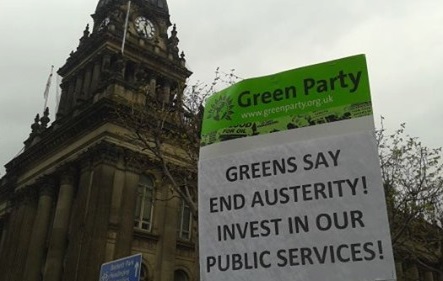 One final irksome part of the British political experience is people who say they “don’t do politics” or “are not political”. My retort to that is politics is everywhere and shapes so much of our lives. The waiting lists in hospitals getting longer are down to a political decision around funding the NHS. Whether public services or social care are available readily available when needed is due to a political decision. Whether there’s enough Teaching Assistants in your local school to help deliver good outcomes for the children is a political decision. And whether or not a zebra crossing is installed to improve road safety will have a political decision somewhere down the line. It may not have resulted in me taking a place on the green benches of Westminster, but one day when I’m older I can look back and think at least I stood up for what I believed in, and achieved an ambition to see my name on a General Election ballot paper.
Here are some other posts about my General Election experiences:
- Tackling voter apathy is crucial to Green Party electoral success 26 June, 2022
- My time as a Green Party General Election Candidate 25 May, 2020
- General Election Candidate 2017 – Questions to the Candidate 25 May, 2020
- General Election Candidate 2017 – Andrew’s views on key issues 25 May, 2020
- General Election Candidate 2015 – Best Green result in Leeds West 25 May, 2020